|
Photosynthesis - what is photosynthesis? Photosynthesis enables plants and algae to convert CO2 and water into vital oxygen and sugar. This is why scientists are also working with photosynthesis in the battle against climate change and food shortages.
Photosynthesis turns carbon dioxide into oxygen and sugar. Text Andreas Ebbesen Jensen | Published on 05.02.24 Table of contents What is photosynthesis? When Earth formed from a cloud of gas and dust around the young Sun approximately 4.6 billion years ago, our planet's atmosphere contained no oxygen. About one billion years later, tiny blue-green bacteria emerged in the oceans and began to produce oxygen. They triggered the development of Earth's oxygen-rich atmosphere, which forms the basis for not only humans, but all animals on the planet to breathe. Oxygen is produced through photosynthesis. Photosynthesis is a biochemical process that enables plants, algae, and some bacteria to absorb the inorganic substances of carbon dioxide (CO2) and water (H20) to form the carbohydrate of glucose, which enables plants to grow. Just as importantly, oxygen is produced as a waste product of the process, making photosynthesis the most important biochemical process on Earth. The formula for photosynthesis is: 6 CO2 + 6 H2O + light energy --> C6H12O6 (glucose) + 6 O2 How does photosynthesis work? Green plants use energy from light through photosynthesis. The process converts the CO2 of the air into oxygen and carbon compounds (sugars). How photosynthesis works Photosynthesis is a process in which plants use microscopic chloroplasts in leaves to capture the energy of light and utilise it to convert water and carbon dioxide into sugar and oxygen.
1 Water (H2O) is carried from the plant's roots to the leaves. 2 Light energy from the Sun splits the water molecules, releasing electrons. 3 Photosynthesis takes place in the chloroplasts of plant cells. 4 Carbon dioxide (CO2) is absorbed through stomata in plant cells. 5 Carbon (C), a building block of the plant, is formed, when electrons released from water split carbon dioxide (CO2). 6 Oxygen (O2) is released by the plant as a waste product of the process. When was photosynthesis discovered? In other words, plants work in the opposite way of humans and animals, which inhale oxygen and exhale CO2 - also known as respiration. This was discovered by Dutch scientist Jan Ingenhousz in 1771. He documented that plants release oxygen bubbles when exposed to sunlight and release carbon dioxide when it gets dark. In 1999, Greenlandic researcher Minik Rosing sensationally found evidence of photosynthesis in Greenlandic rock. The evidence came in the shape of carbon deposited by cyanobacteria, also known as blue-green algae, 3.7 billion years ago. Photosynthesis is undoubtedly the most dramatic thing that has happened to life on Earth. Minik Rosing, Professor of Geology at the University of CopenhagenLike plants, cyanobacteria convert sunlight into chemical energy and produce oxygen as a waste product. All the oxygen the bacteria produced in the oceans through photosynthesis over the next hundreds of millions of years provided a breeding ground for new and more sophisticated life forms.
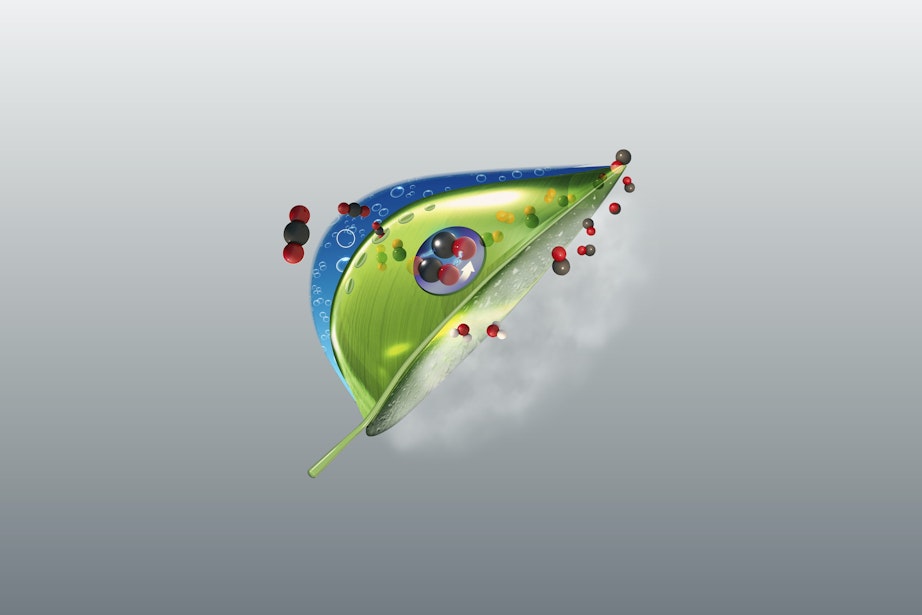
Cyanobacteria have existed for 3+ billion years, and their oxygenic photosynthesis forms the basis of all life on Earth as we know it. © Shutterstock In the course of several geological periods, cyanobacteria pumped oxygen into the environment. Initially, the oxygen was chemically bound by substances such as iron, so it did not end up in the atmosphere. Over time, however, the oxygen from photosynthesis filled the atmosphere. In addition, the ozone layer, which protects life from the Sun's ultraviolet radiation, was formed. For the past two billion years, Earth has had an oxygen-rich atmosphere, and calculations show that today, 280 billion t of oxygen are produced on Earth every year. 46 % of the oxygen are produced in the oceans by algae and cyanobacteria, while the remaining 54 % are produced on dry land. This corresponds to 21 % of the atmosphere (the rest of the atmosphere is made up of nitrogen, CO2, and other gases). 46 % of the oxygen are produced in the oceans by algae and cyanobacteria, while the remaining 54 % are produced on dry land. Video: NASA observes photosynthesis from spaceHundreds of km from Earth's surface, satellites detect the invisible light - fluorescent light - that plants emit during photosynthesis. Climate change and photosynthesis For millions of years, the ratio of oxygen to CO2 was in natural balance in the atmosphere, but over the past few decades, the balance has been disturbed. In 2019, global atmospheric CO2 emissions reached 37 gigatonnes, which is 30 % higher than in the 1970s. Scientists widely agree that the increase in CO2 emissions is due to the burning of fossil fuels, which explains why natural photosynthesis cannot keep up - and why CO2 levels in the atmosphere are steadily increasing. Therefore, research is also being done to find new ways to store or capture CO2, so that the concentration in the atmosphere does not continue to skyrocket. Artificial leaves perform photosynthesis Artificial leaves that mimic nature's photosynthesis have been invented several times. Unfortunately, they have all shared the same problem. The leaves can convert CO2 from pressurised tanks in a lab, but they cannot extract CO2 from ordinary atmospheric air. Until now. In 2019, researchers developed a special membrane that can solve the problem. The membrane encapsulates the artificial leaf and bathes it in water while it performs photosynthesis. When the sunlight heats the water behind the membrane, it can evaporate through the subsurface of the leaf and absorb CO2 through small slots on the surface of the leaf. The slots are similar to the stomata of natural leaves. A light-absorbing material captures energy from sunlight, which, together with a number of auxiliary substances, triggers photosynthesis in the artificial leaf. The artificial leaf converts CO2 into oxygen and carbon monoxide (CO). The oxygen can be captured or released, while the carbon monoxide can be used in synthetic fuel. How artificial leaf photosynthesis works Scientists have invented a membrane that envelops artificial leaves in water, enabling the leaves to draw CO2 from the air and hence provide themselves with the raw material for photosynthesis.
1 Water evaporates When the sunlight heats the water behind the membrane, it can evaporate through the subsurface of the leaf. As the water vapour leaves the leaf, CO2 is drawn in through small stomata on the surface. 2 Photosynthesis is kicked off With ample quantities of CO2, the leaf can perform photosynthesis, converting the greenhouse gas into oxygen and carbon monoxide. 3 Fuel escapes While natural leaves produce sugar, the end product of the artificial leaf is carbon monoxide, CO, which can be used in synthetic fuel. Wrapped in researchers' new membrane, artificial leaves can extract 10 times more CO2 from the air than a regular leaf with the same surface area. In practice, an artificial leaf will look like a solar panel, and a park of 360 panels will be able to remove 792 kg of CO2 from the air per day. Animals that use photosynthesis Those are three remarkable animals that mimic the ability of algae and plants to perform photosynthesis, allowing them to harvest energy from sunlight.
Sea slug harvests chloroplasts The Elysia chlorotica sea slug sucks chloroplasts out of the algae with a straw-like structure, absorbing them into its cells, so it can convert sunlight into energy.
Pea aphids produce pigments The pea aphid (Acyrthosiphon pisum) produces plant pigments that likely enable the insect to harvest energy from sunlight.
Salamanders parasitise on algae The spotted salamander (Ambystoma maculatum) is colonised by algae in the embryonic stage, when the egg grows in water. The embryo hoards oxygen and glucose from the algae, as they perform photosynthesis. Researchers hack photosynthesis In 2019, a new international research project known as Realizing Increased Photosynthetic Efficiency (RIPE) succeeded in genetically modifying the leaves of tobacco plants to make them much more efficient at photosynthesis. When plants capture carbon dioxide from the air, they do so via the rubisco enzyme. Unfortunately, the enzyme not only captures carbon dioxide, but also oxygen, producing toxins that the plant requires energy to break down. This detoxification process means the plant has less energy to convert the CO2 into glucose, which fuels the plant's growth. The researchers' genetically modified leaves made detoxification in tobacco plants much more efficient, causing the plants to grow faster and up to 40% larger compared to normal tobacco plants. The next step is to test the method on tomatoes, soybeans, and similar plants, so that plant-based food production can double over the next 50 years, which is necessary to feed a world population expected to hit nine billion by then. (责任编辑:) |